In Wim Wenders’s iconic 1987 film Wings of Desire, the Berlin Wall is a character. In Ola Mafaalani’s theatricalization of the work for Toneelgroep Amsterdam and the American Repertory Theatre (at the Loeb Drama Center through December 17), the Fourth Wall is. Melting the barrier between pure spirit and mortal flesh is central to the film’s story of an angel who falls in love with a human and gives up his immortality for her. But the new theater piece based on Wings (whose German title is Der Himmel über Berlin) endeavors to push through the divide between stage and spectators as well. Along with the dwarfed gaggle of characters interacting (and not) in the vast, exposed stage house of the Loeb, we are the crush of humanity, thinking our thoughts, feeling our isolation amid the crowd, as our existence is acknowledged and witnessed by notebook-toting angels. The muse of storytelling, the old poet Homer, teeters right down to the edge of the stage to address us. And when the angel Damiel decides to “enter the stream,” trading eternity for a more visceral experience of the world, it is into our midst that he comes seeking to learn touch and color.

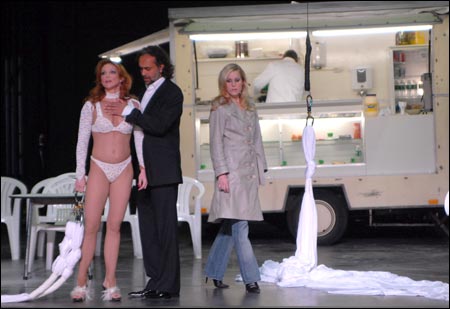
BETWEEN HEAVEN AND EARTH: Learning “wonderment” in mid air. |
Of course, unlike the Berliners of the movie, we’ve been able to see him all along, which makes rather an intellectual hash of the conceit. One wonders whether Wenders’s vision of angels sweeping like otherworldly cameras over the warrens and highways of Cold War Berlin, in one sense a meditation on filmmaking, can really be twisted into a meditation on theatricality. To me, the effort seems strained. On the other hand, the deliberately self-conscious theater piece boasts a physical immediacy that is most piercing at the end. Those closest to the stage can almost reach out and touch Damiel and the trapeze artist, Marion, as she gently places him in the white sling of her rigging and then draws him into her aerial dance. Without a net, without trick photography, one feels the danger, as well as the beauty, of this lonely woman and newly minted man coupling in air, learning “wonderment.”
Another border being crossed here is between theater organizations and nations. Indeed, collaboration with the avant-garde artists of Europe’s better-subsidized and therefore less hurried companies is high on ART artistic director Robert Woodruff’s list, whether in repurposing the classics or creating new works. (Wings of Desire is a little of each.) This production has been in the works for two years, the key architects being Mafaalani, whose idea it was to adapt the film, and ART associate artistic director Gideon Lester, who spearheaded the adaptation of the screenplay by Wenders, Peter Handke, and Richard Reitinger. (Lester and the Ko van den Bosch are credited with the translation; Toneelgroep Amsterdam dramaturg Dirkje Houtman is co-adapter.) The cast includes both American and Dutch performers. And when the piece debuted in Amsterdam in October, the script meandered between languages, most Dutch people being fluent in English. At ART, Dutch is mostly relegated to a couple of smoky songs performed by Hadewych Minis, one of two musicians (the other is American actor/musician Jesse Lenat) who perform Ex guitarist Andy Moor’s now mood-inducing, now cacophonous rock score (which, when Damiel shakes on his mortal coil and a veritable block party breaks out on stage, threatens to break the barrier of the human eardrum).
Among the ways in which Wings is torn out of history and repositioned in the present is the addition of a newscaster, in this case WBUR’s Robin Young, who takes her place from time to time at a table under a huge light to read the news of the day — and at one point to recite from Rainer Maria Rilke’s Duino Elegies. As befits the decision to remove Wings from divided Berlin to the stage itself, the theater piece eschews illusion — stunningly. What’s on stage are a bunch of white plastic chairs, a few café tables, and the snack truck where, in the film, former angel Peter Falk senses Damiel’s presence and invites him to cross over and drink coffee while smoking a cigarette (“If you do it together, it’s fantastic”). But in a simple visual coup by set designer André Joosten, the passage between Heaven and Earth takes the form of cylinders of falling sand, though which both a man crossing into death and the angel crossing into life must travel. That most of the cast, passing through these hourglass-like cascades, must wander around looking as if they had bad cases of dusty dandruff seems a small price to pay for the effect, which is magical (especially as Damiel, with utmost delicacy, cradles the dying man under his shower of sand). Of course the stage does get to be a bit of a sandbox; as part of the party, complete with thunderous rock and dancing and a kid on a skateboard, that explodes as Damiel crosses over, a whole lot of sweeping goes on.
