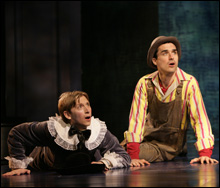
LOVE’S LABOUR’S LOST: The eyes — and ayes — have it.
|
The eyes have it in Love’s Labour’s Lost, in which ocular imagery duels with what Harold Bloom calls a “florabundance of language” in the arch arias of courtier Berowne, who sees himself writ large in the “pitch-ball” peepers of Rosaline. And with the Huntington Theatre Company production of the early Shakespearean comedy (at Boston University Theatre through June 11), the ayes have it too. Nicholas Martin’s Edwardian-set staging, gorgeously appointed and as well pruned as topiary, is charming. As Berowne, in whom narcissism duels with sparkling logorrhea, Boston University graduate Noah Bean exudes a boyish innocence that ameliorates the character’s exuberant showiness. And the stock comic characters’ displays of intellectual and semantic pretension, which can be tedious, aren’t. In fact, Will LeBow’s ivory-tickling rendition, in the guise of twirly-mustachio’d Don Adriano, of a ditty called “The Spaniard Who Blighted My Life” is an interloping highlight — particularly the flourish in which the singer, decrying the man who stole his wife, promises to plant “my bunion in his Spanish onion.”As you may have gleaned, Martin puts a gloss on Shakespeare in more ways than one, though neither the production’s updating nor its additions to the Shakespeare songbook get in the way of the play. Through the centuries, Love’s Labour’s Lost, which was written around 1594, has been both underrated and overrated: William Hazlitt opined that “if we were to part with any of the author’s comedies, it should be this,” whereas Bloom testifies to taking “more unmixed pleasure from Love’s Labour’s Lost than from any other Shakespearean play.” Bloom also harrumphs that he’s never seen a production that lived up to the work’s “vocal magnificence,” and who knows what he’d say to this one? But those with less lofty demands will find enough froth here to top a cappuccino (a word some of the characters would doubtless confuse with “Arlecchino” — or maybe “maraschino”).

LLL is set in groves of academe: the castle park of the King of Navarre, who along with three friends has resolved to devote three years to study and a near-monastic life in which women are to play no part. When the Princess of France (the savvy, elegant Mia Barron) shows up with a retinue of ladies, the King receives them of necessity but, having declared his palace off limits, puts them up in tents in the park. He and his posse then proceed to fall, with convenient precision and hierarchical neatness, in love with the four visitors (who in the whimsically opulent Huntington staging arrive in a little yacht afloat in a muted Monet sea, from which a dinghy is disgorged like a babe from the womb to float in from the wings at larger scale). It falls to the verbally agile Berowne to devise the logical back flips in verse that might release the scholars from their vows — and to disdaining Rosaline, given an exotic snap by Zabryna Guevara, to release him from pride in his every witty phoneme.
In a speech as rallying as Henry V’s on St. Crispin’s Day, Berowne argues that “love, first learned in a lady’s eyes,” nourishes not just the brain but all the senses and indeed the world. By the time he’s fired his way through this heady rationalization, in which women “are the books, the arts, the academes,” love has trumped a PhD. Except for an autumnal twist (nicely foreshadowed here by a tall, climbable tree shimmering green and gold), all might be well that ends well. But even if the play concluded with the multiple marriages that tie up most classic comedies, you’d be left with the nagging suspicion that the lads of LLL were more caught up in their own sighing and sonnetizing than in their dismissive sweethearts with the mirror eyes.
Elsewhere in the play, the Bard riffs on themes of pretense and lust through more countrified (or otherwise ridiculous) characters, some of whose more arcane interlocutions have here been washed away with the then-topical allusions. The comedy that remains is sharply performed, often with a music-hall panache, particularly by LeBow as the deliciously oleaginous, parading Don Adriano and Jeremy Beck done up like Little Lord Fauntleroy as his precocious performing seal of a page. The production even comes with its own tuxedo’d accompanist, Robert Mollicone, who’s seated at a grand piano to one side before the stage. And composer Michael Friedman sets Shakespeare’s concluding songs evoking spring and winter to a ragtime beat that segues from jaunty to melancholy, just like the play.
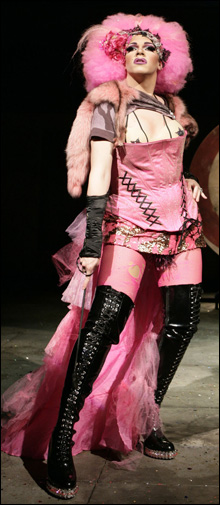
ISLAND OF SLAVES: Avant-garde ART retooling that works.
|
“Mirror mirror on the wall, who’s the biggest queen of all?” barks the curtain-call number of American Repertory Theatre’s Island of Slaves (at the Loeb Drama Center through June 11). And that is the question of the evening, whether you’re talking drag or divine right. Pierre Marivaux’s play — or more accurately, his scenario written for an Italian commedia troupe in Paris — hails from 1725 and has to do with the brutal relations of masters and servants. A male and female pair of each is shipwrecked on an island operated as a democracy by runaway slaves, and they’re forced to trade roles for purposes of retraining. ART artistic director Robert Woodruff has come up with the brilliant idea of replacing the islanders, unconventionally liberated for their time, with a quintet of in-your-face drag queens milling about a down-at-heels lounge called Utopia. But the real setting of this provocative and highly theatrical work is the theater itself — as we learn at the get-go when treated to video of Karen MacDonald’s Euphrosine, done up in full 18th-century frippery and followed by tired maid Cléanthis, mincing up Brattle Street and into the Loeb lobby before the two burst in person into the arena playing space, a sort of nightclub patio decorated with cheap, upturned lawn chairs and at least one discarded condom.I know, I know, it sounds like so much avant-garde ART retooling. But the metaphor of the drag queens works, as does their vampy, empowered lip-synching to loud disco. (Except when they force themselves on the audience.) And reacting to the screed-like denunciations and role-reversal humiliations of the script with things like “Not today, baby,” they are funny. Moreover, Woodruff knows when to get them out of the way, relegating them to a seedy green room at the back when the play needs to bite in a different way. Bite it does. Marivaux’s hypothetical experiment in social engineering results in some real theater of cruelty, and we feel the pain. And not just when something flashy happens, as when MacDonald’s shamed aristo is stripped to her slip, smothered in a piggy mask, and spun on a wheel while being spray-painted by the imposing drag queens. Almost more awful is the discovery that the servants turned master and mistress, after a failed, stiff attempt to romance each other, really lust for the actual masters. Which suggests that a slave mentality is something it may take generations, rather than some sadistic role reversal, to displace.
