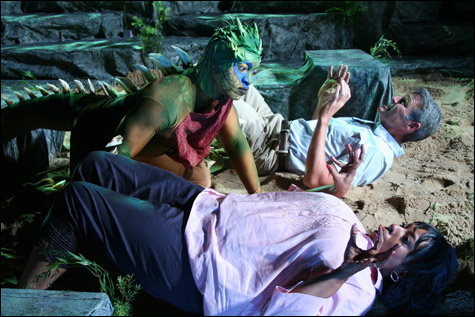
SEASCAPE: The lizards are cute, but less is still more. |
Seascape, Edward Albee’s 1975 Pulitzer-winning meditation on evolution and mortality, gets all wet at Zeitgeist Stage Company. The feisty troupe is presenting the American premiere of the playwright’s whimsical existential fantasy in its original three-act form (at the Boston Center for the Arts Plaza through October 25), in which the playwright splices in an episode of The Little Mermaid. Here the play’s at-odds aging couple, having had an energizing if initially terrifying beachfront encounter with a pair of giant lizards just up from the briny, are dragged back into it by their reptilian counterparts. The play, in this initial version, was presented in the Netherlands prior to the sleeker edition’s Broadway premiere. But this is the first time it’s been produced on American soil (well, American sand, four and a half tons of it dragged by Zeitgeist into the BCA) — and for good reason.
Sure, a peek at Albee’s rough draft will prove interesting to theater scholars. It’s interesting to me, less for the gleaming moray-eel eyes and plastic lobsters of the excised act than because it places the final version’s hopeful conclusion at the close of act two and substitutes a tougher ending redolent of Who’s Afraid of Virginia Woolf?, in which the human couple are left to make do with each other. But this original Seascape, most of the content of which made it verbatim into the shorter version, both belabors the play and interferes with its inner — not to mention its evolutionary — logic. We can’t, after all, be sure that massive English-speaking lizards won’t appear in Montauk or on Cape Cod, raring for a chat. But we do know that humans shanghai’d to the ocean floor would drown — unless they suddenly grew gills, and wouldn’t that be anti-evolutionary? Just asking.

Zeitgeist honcho David J. Miller is always up for a challenge, but this one seems less an ambitious leap than a stunt — though the director’s reasons for doing the play in the first place are thoughtful enough. In addition to restoring Albee’s journey to the bottom of the sea, Miller’s production addresses the playwright’s displeasure with the 2006 Lincoln Center revival (the work’s first Broadway appearance since its initial two-month run), which focused on Seascape’s comedy of inter-special manners. Miller’s production is more earnest, emphasizing the play’s mordant ruminations on evolution — on whether the knowledge of mortality and the naming of emotions are really preferable to a mindless swim in the primordial soup.
Miller has designed a credible beachfront set (though the geographical relationship of the sea to the sandbox is confusing), and Jeff Adelberg provides aptly murky lighting for the underwater episode. Moreover, Miller directs Claude Del and Emma Goodman, as the play’s curious if occasionally belligerent lizards, to slither, crawl, and tumble deftly about the rocks. As simply and inventively costumed by Fabian Aguilar, the pair of spiky, green-tailed biguanas are cuter than scary but for the most part reptilian in behavior (if human in gender dynamics). And the production picks up considerably once they pop up behind the dunes, in part because Del and Goodman have a better handle on Albee’s precise, concise rhythms than do Peter Brown and Michelle Dowd as their human counterparts, Charlie and Nancy.
